IPMorama: major European advances in plant variety resistance and integrated crop protection
The aim of IPMorama is to develop integrated pest management strategies centred on varietal resistance to various pests affecting wheat, potatoes and legumes to reduce the use of pesticides.
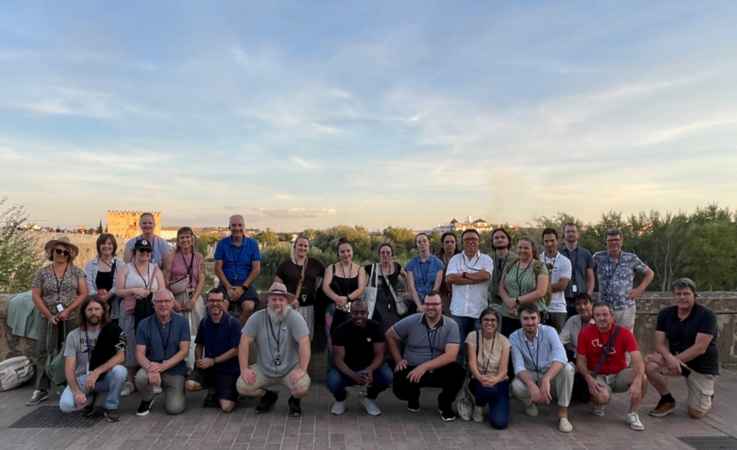
Organised by the CSIC (Consejo Superior de Investigaciones Cientificas) campus under the auspices of Teagasc, GEVES took part in the second annual meeting of the Horizon Europe IPMorama project from 14 to 16 October in Cordoba (Spain).
At this meeting, a review of the most significant progress was presented, along with the launch of a survey on integrated pest management strategies focusing on varietal resistance. The survey is open to all stakeholders in the sector, and we invite you to complete it in no more than 15 minutes. You will find all the information you need to access the survey at the bottom of this page.
For GEVES, this was an opportunity to communicate with INRAE in Moulon regarding progress in data collection to enable the spatio-temporal monitoring of the spread of varietal resistance at European level for the three types of rust (yellow, brown and black) affecting soft and durum wheat, and potato late blight.
In partnership with Aarhus University in Denmark and INRAE BIOGER, GEVES also reported on the results of the 2026 epidemiological monitoring of rust diseases in Europe.
GEVES continues to coordinate, at European level, a set of sentinel varieties (including differential hosts and susceptible control varieties) established at 85 VSCU and seed production sites across 20 European countries. Severity ratings showed a high incidence of brown rust at 70% of sites, a moderate incidence of yellow rust (>50%) and a low incidence of black rust (<9%). This monitoring of sentinel varieties within the European VSCU network helped to provide an early warning of the spread of Yr15 virulence of the new Champion race of yellow rust, detected on the Mariboss sentinel variety, in eight countries: Belgium, Germany, France, the Netherlands, Poland, Denmark, Norway and Hungary. The brown rust sentinel varieties demonstrated that the Lr28 resistance had been bypassed at 47% of the sites, and at half that rate for Lr24 (23.4%), whilst bypass of both Lr24 and Lr28 was observed at 32% of sites across eight countries.
For the new 2026–27 campaign, GEVES will monitor the deployment of 82 sets of sentinel plots from 30 institutes across 18 countries.
Finally, under the auspices of INRAE BIOGER, GEVES contributed to the initial findings of a field trial involving mixed varieties of winter wheat, designed to delay the emergence of new strains of yellow or brown rust whilst preserving the longevity of the resistance sources used.
Your opinion matters: take part in the IPMorama project’s European survey
The aim of this online survey is to identify and analyse the social, economic and technical barriers and drivers influencing the adoption of integrated protection strategies centred on varietal resistance within European agri-food sectors. The results will be used to develop a framework for knowledge sharing, as well as communication materials designed to support the transition towards more sustainable agriculture based on varietal resistance and integrated pest management.
The survey is aimed at:
- Public decision-makers;
- Breeders;
- Researchers;
- Variety evaluation and registration bodies;
- Agricultural advisers;
- Traders and distributors;
- Processors and manufacturers;
- Producers;
- Civil society organisations;
- Consumers.
We would like to thank you very much for your contribution to this European initiative to promote more sustainable agriculture.
This survey is available in several languages.